COP31 in Antalya: electrification takes centre stage, carbon markets get to work
Week one of COP31 put a global electrification target at the heart of the summit, while Article 6 moved from rule-making to deal-making. What it means for carbon credit sellers, buyers and exporters..
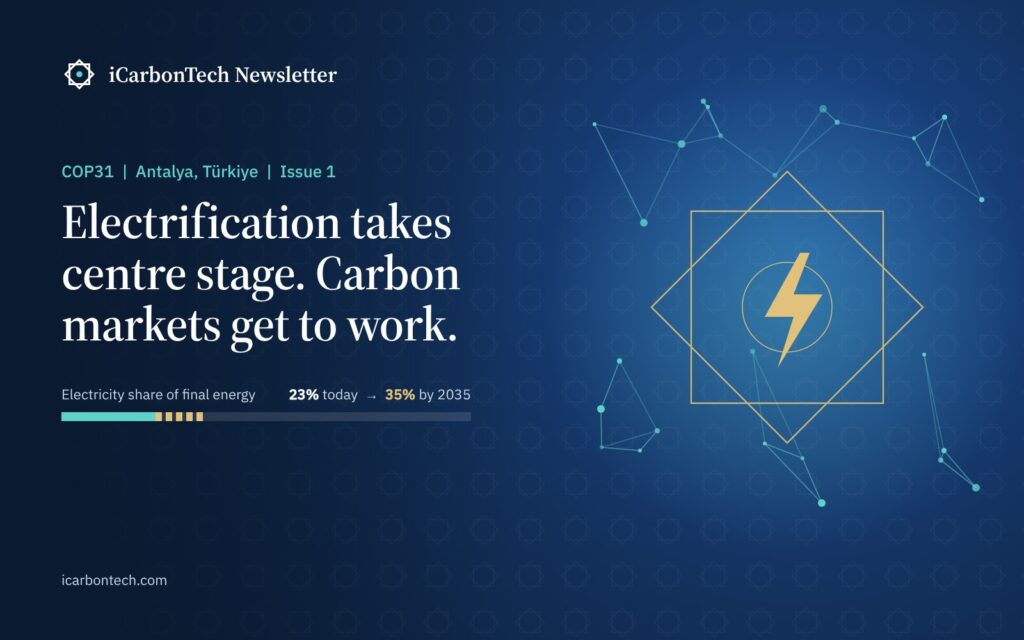
iCarbonTech Newsletter | Issue 1 | 15 November 2026
COP31 is halfway through. The conference is being held at the Expo Center in Antalya, Türkiye, from 9 to 20 November 2026, and it has a clear theme. The host presidency wants this to be the summit of electrification, and carbon markets are finally being judged on delivery rather than rules. Here is what happened in week one, and what it means for our clients.
1. Electrification: the "35 by 35" pledge
The headline initiative is a voluntary global target. Türkiye is asking governments to lift electricity's share of global final energy consumption to 35% by 2035, from about 23% today. COP31 President Murat Kurum said that reaching this goal would require more than a fourfold increase in the annual pace of electrification.
Support is building. At least 14 countries had endorsed the pledge by 12 November, although island nations warn it must not distract from the shift away from fossil fuels. European Commission President Ursula von der Leyen has backed the pledge, and the EU was expected to endorse it formally. Business is on board too: 180 companies with $1.69 trillion in annual revenue support the initiative, and members of the Utilities for Net Zero Alliance (UNEZA) will raise annual investment in grids, renewable energy and storage to at least $156 billion.
The debate is about quality, not ambition. The pledge does not require additional electricity to come from clean sources, and each country decides its own energy mix. For developing countries, finance is the test: IRENA estimates that annual investment in grids must double, from $0.5 trillion in 2025 to about $1 trillion a year between 2026 and 2035.
2. Carbon markets: from rules to transactions
Article 6 is quiet in the negotiating rooms and busy in the side rooms. No negotiations are scheduled on Article 6 market rules, and a formal review of the rulebook will not start until 2028. Both the Article 6.2 and Article 6.4 mechanisms face budget shortfalls, and countries are expected to consider more funding.
The numbers show both the potential and the gap. 31 countries have authorised more than 348 million credits for international transfer, yet just over 150,000 ITMOs have actually been delivered. Cookstove projects account for just over half of all authorisations. Under the new UN crediting mechanism, five methodologies have been approved, and 415 projects moved from the old Clean Development Mechanism by the 30 June deadline.
Supply-side readiness is improving fast. MSCI reports that 34 countries now score high or very high on Article 6 readiness, up from 20 in April. Authorisation pays: CORSIA-eligible credits trade at roughly four times the price of credits that are not yet eligible.
Deals announced in week one include:
- Singapore and Bangladesh agreed to pursue an Article 6.2 implementation agreement.
- Singapore issued its first Letter of Authorisation under its Article 6 deal with Rwanda.
- Luxembourg is seeking Article 6 credits to cover government air travel emissions.
- Oman's Article 6 authority signed agreements with Gulf-based carbon experts.
- Germany announced a €50 million fund with KfW to boost international carbon markets.
- UNCTAD launched a Global Carbon Market Network to connect fragmented carbon markets and direct investment to developing countries.
3. Where electrification meets carbon markets
The two agendas are closer than they look. Electrification needs capital in exactly the countries where carbon markets can supply it. Clean cooking, electric two- and three-wheelers, mini-grids and grid-connected renewables in developing countries can all generate credits, especially when a host government authorises them under Article 6. Zambia has already shown one model: its Article 6 agreement with Norway supports new renewable power through performance-based payments for verified results.
For exporters, cleaner electricity also cuts the emissions embedded in steel, aluminium and fertilisers, and with them future EU CBAM costs. As host, Türkiye sits at the centre of both trends: its national emissions trading system took legal effect on 27 August 2026 and covers the same sectors as CBAM.
4. What to watch in week two (16 to 20 November)
- Whether the final decision includes a signal on clean electrification and on the transition away from fossil fuels.
- Funding decisions for the Article 6.2 and 6.4 infrastructure.
- More endorsements of the 35 by 35 pledge, and whether finance is attached.
- New bilateral Article 6 agreements and Letters of Authorisation, especially from the Gulf, Africa and Asia.
What this means for you
Project developers: Article 6 authorisation and CORSIA eligibility now carry a clear price premium. Start the authorisation process early.
Buyers: the supply of authorised credits is growing, but delivery is slow. Secure offtake from projects with a credible issuance record.
Exporters: electrification and clean power are becoming a CBAM strategy, not only a climate one.
iCarbonTech connects carbon credit sellers, project developers and carbon companies with buyers, clients and finance across Türkiye, the GCC, the EU and Africa. Book a call at icarbontech.com/book-a-call or write to contact@icarbontech.com.
Sources: Climate Home News; World Resources Institute; Reuters; Carbon Pulse; CarbonCredits.com; OPIS; ClearBlue Markets; MSCI; Down To Earth; Table.Media; Africa Sustainability Matters; S&P Global.